
Member Spotlight – Armin Reisinger
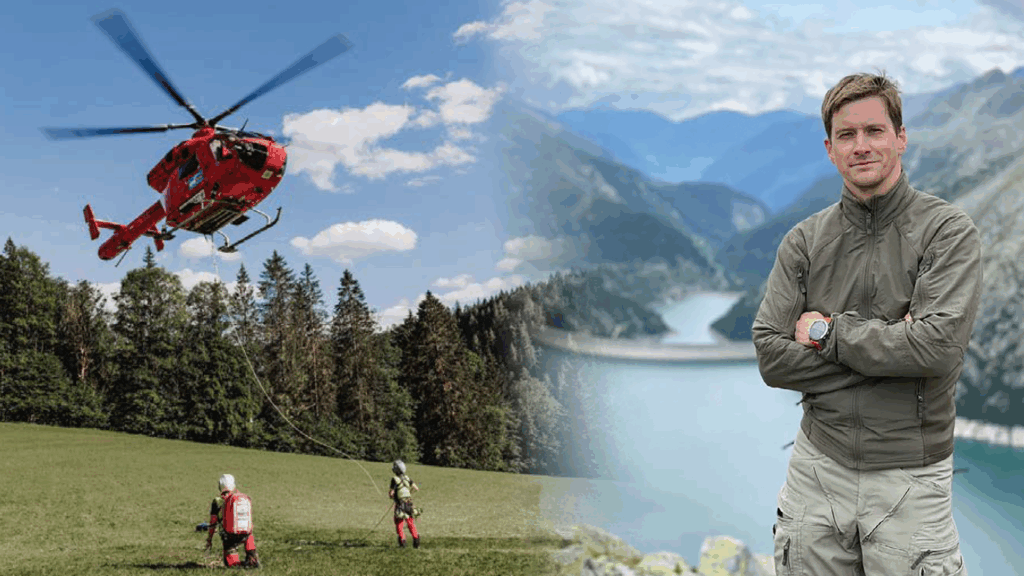
Armin Reisinger, Paramedic, Austria
After graduating from college, Armin Reisinger worked as a railway engineer in Linz, a city on the Danube River at the foot of the Austrian Alps. In his free time, he served as a volunteer EMT. “In Austria, about 80% of EMS is provided by volunteers,” Reisinger explained. When an economic crisis hit in 2008 and his company was planning job cuts, his employer asked if he could see himself in any other role. Reisinger suggested he train to become a paramedic for the company’s internal EMS department. The department handled medical emergencies among the 15,000 employees in a large industrial complex, which housed an onsite steel mill and smelting facility. Reisinger never went back to engineering. He went on to work for both ground and helicopter EMS agencies, rescuing skiers, hikers and rock climbers who got into trouble in the mountainous terrain.
Reisinger is also an NAEMT affiliate faculty for Advanced Medical Life Support (AMLS), Emergency Pediatric Care (EPC) and Prehospital Trauma Life Support (PHTLS). He is also NAEMT’s national education coordinator for Austria, and a member of the NAEMT Regional European Education Committee, which promotes and supports NAEMT education throughout Europe. In December, Reisinger and his colleagues from the Austrian Paramedic Association will host the annual Regional European Education Committee meeting in Vienna, held in conjunction with an Austrian EMS conference that’s open to all prehospital practitioners in the country.
The highest peak in your area is nearly 10,000 feet. Tell us about a challenging rescue you did at high altitude.
It was a young woman in a paraglider accident this fall. She was the third difficult call that day. Right before, we responded to a crash that involved a patient with hypothermia and multiple, severe injuries, and then we had a CPR call. Witnesses had seen her crash into the mountain, but they didn’t know exactly where she was. We flew up and searched but didn’t find her. We had to come back down to refuel. The second time, we found her. She was hanging from a rock on a very steep wall. You could see
she was badly injured. We thought she was dead. But when she heard us, she flashed a thumbs up sign, and then she went unconscious again.
HEMS crews in Austria include three people: a pilot, paramedic and a physician. We found a place where we could hover a bit above the ground and drop off the physician. He tried to climb to her, but it was too steep. One bad step and he could fall. We told him if it was too dangerous, stay where you are, and we’ll come get you.
We found a place to land near the summit and I prepared the line that connects my harness to the helicopter. We flew back to where she was and I lowered myself out of the helicopter, about 200 feet down. The helicopter couldn’t get too close because of the downwash from the rotor. The downwash could easily fill the chute, which could hurt the patient or destabilize the helicopter and cause it to crash. She was in a lot of pain. I tried to calm her down, but due to the critical situation we had to focus on getting her out of there. The parachute strings were caught in rocks and trees. I was having trouble cutting through the cords, but I finally was able to release her and get her attached to my harness. We picked up the doctor, and the three of us were lifted into the helicopter.
Her injuries were severe. She was hypothermic, had a crushed nose, several broken ribs, and fractures in her pelvis, lumbar spine, and leg. We flew her down the mountain and stabilized her, then we brought her to the trauma center. I was happy to know she survived without any lasting damage.
How did you get involved with NAEMT?
I took an AMLS course, which at the time was new in Austria. I became an AMLS instructor in 2012, and then an instructor for PHTLS and EPC. NAEMT courses have become very popular among paramedics and employers since they were introduced to Austria in 2008. Our students are about 50% paramedics and 50% emergency physicians. In our EMS systems, we work as a team with physicians in the field. If a doctor wants to become an EMS physician, PHTLS, AMLS and EPC are usually required. Experienced doctors will also take the courses. They sometimes come in thinking they’ve already seen everything and they won’t get much out of the course. Then they are surprised when they learn something new. I had one who said, “I’m working for 30 years as an EMS physician, but that was really interesting.”
What do you like best about being involved with NAEMT and the global EMS community?
I’m very interested in visiting EMS systems around the whole world. I’ve visited agencies from the East Coast to the West Coast of the U.S., Hawaii, Mexico, South Africa, Europe and Australia. It started with the first time I went to EMS World Expo in 2015 and attended NAEMT’s International Reception. From there, I grew my international network. I was interested in learning about how other systems work that are different from ours. Here, we always have a doctor onboard, but not everyplace does, so I
wanted to know: How does that work? Some places also see different types of injuries, like gunshots and drug overdoses, which we don’t see a lot of. I like to bring the knowledge and ideas home.
If you go on the ambulance in different countries, you see the whole society, from poor to rich. You are in people’s homes and you see how they live. It’s not so superficial as being a tourist. EMS is the best way to learn about the “behind the scenes” of a country or a society. Some people go on the beach for the holidays and some other crazy people go on an ambulance. I’m still in contact with some of the paramedics I visited years ago. I think the paramedics in the field are a very big family around the world. Everybody is out to help the other.
More Articles