
NAEMT UK Partner Achieves Royal Charter Status
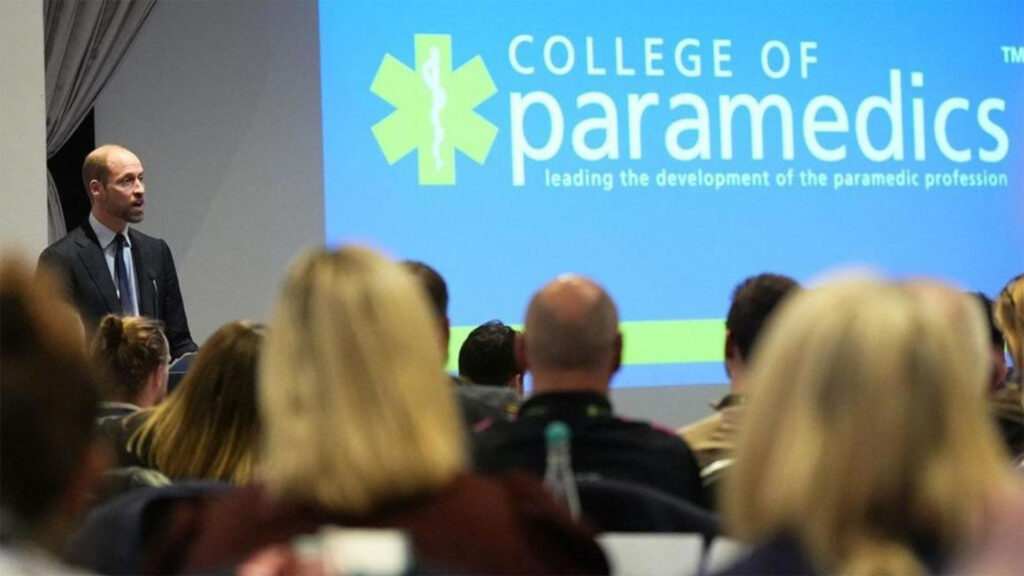
NAEMT is proud to celebrate and recognize the College of Paramedics in the United Kingdom on receiving its Royal Ascent and becoming the Royal College of Paramedics.
The Royal College of Paramedics is the overarching organization which liaises with NAEMT as its partner in the UK. NAEMT has had a longstanding relationship with the UK and was pleased to welcome the transfer of partnership from the Royal College of Surgeons in 2017 to be affiliated to the College of Paramedics whose mission and visions were aligned.
Royal Charter status is strictly controlled and given sparingly by direct permission and authority of the King.
This was awarded in recognition of the College’s objectives to inspire and enable all paramedics to participate in the profession within an environment based on safety, collegiality, inclusiveness, mental and physical wellbeing, and innovation.
It is therefore an additional privilege that the College’s first Royal Patron is His Royal Highness The Prince of Wales, who himself has experienced the realities of EMS work in his role as an air ambulance pilot for the East Anglian Air Ambulance charity. His ability to connect and understand the unique roles and challenges our profession faces make his patronage an extra special and meaningful connection.
Some of the very first implementor sites of NAEMT education to the UK were the then Surrey, Bedford and Hertfordshire Ambulance Services and ambulance charity from Cornwall (FLEET). Leading paramedic educators introduced the Pre Hospital Trauma Life Support (PHTLS) course in the mid 1990’s which went on to where the College is now responsible for several UK adapted editions of the course and its own UK specific exam, delivered across 44 approved NAEMT training centers from private, charity, and statutory backgrounds.
NAEMT, famous for its PHTLS foundation, now promotes several other educational programs, some that look specifically at different patient age demographics, community practice, all hazards response, medical life support and very recently mental health resilience.
As announced within the UK’s Strategic Defence Review (2025) The UK’s commitment to NATO and its partners extends specifically to the roles of the Defence Medical Services and with this, application of the latest Tactical Combat Casualty Care (TCCC) practices. NAEMT is proud of the relationship it has with the United States Defense Health Agency (DHA) in overseeing the international accreditation of its TCCC program to support global military units, as well as its civilian Tactical Emergency Casualty Care (TECC) courses adopted by some tactical medical responders in the UK.
As a signatory of the UK’s Armed Forces Covenant, the Royal College of Paramedics also liaises on behalf of NAEMT in the UK to support the development of TCCC education through its network of approved military centers, as well as more broadly to the wider armed forces as they deliver increasingly aligned UK TCCC education themselves.
Chief Executive of the Royal College of Paramedics, Tracy Nicholls OBE who herself was an accredited NAEMT PHTLS Instructor, said “I am immensely proud of our long-standing affiliation with NAEMT and the strength of the partnership we have built over many years. The education being delivered, particularly to our military colleagues, is both timely and highly relevant, reflecting the evolving demands placed on modern prehospital and defence medical practice. NAEMT’s commitment to evidence-based, internationally respected programmes aligns closely with our own mission, and it is a privilege to work alongside colleagues such as Scott King, whose leadership and dedication through the Royal College continues to strengthen our shared impact and support the highest standards of patient care.”
Scott King, the Royal College of Paramedics UK NAEMT National Coordinator, said “As an active advocate and instructor with NAEMT for over two decades, being able not only to deliver these vital educational programmes—at a time when paramedics and all grades of EMS staff can benefit so greatly in order to deliver better patient care—but also to represent the UK and our practices globally, and to help shape the future of international practice and NAEMT programmes, is a true privilege. It gives me immense pride in the role the Royal College has for our profession. I am grateful to the many paramedics who came before me, whose long-held aim of achieving Royal Charter status has now been realised.”
More Articles