
Member Spotlight: Five Decades in EMS and Still Learning with John Zartman
NAEMT Board of Directors: Getting to know the leaders who move our profession forward.
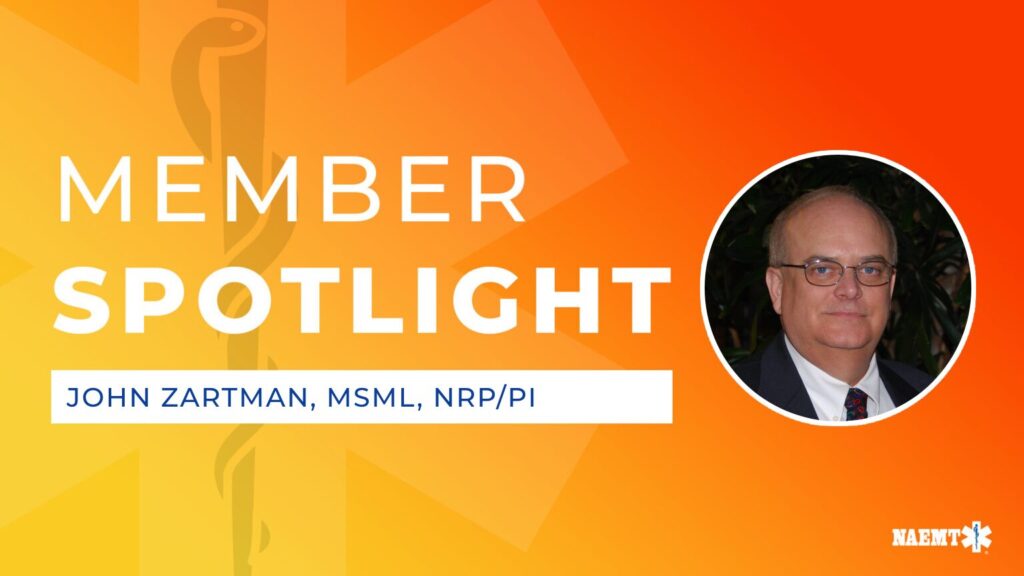
John Zartman, MSML, NRP/PI, is the Director of EMS for Tippecanoe Emergency Ambulance Service in Lafayette, Indiana, and serves as the Midwest Region Director on the NAEMT Board of Directors. His EMS career began in 1973 when he took one of the first EMT classes in Indiana, and he became a paramedic in 1979. Over more than five decades, John has worked as an EMS director, educator, and program director. Today he serves on the Indiana State EMS Commission, chairs the Indiana EMSC Education Oversight Committee, and is the State Coordinator for NAEMT’s education programs. He is also a recipient of the Indiana EMS Association’s Golden Siren Award. We asked John to reflect on the advice he would give his younger self, how AI and data will shape EMS, and what made him say yes to board service.
Q&A with John Zartman
Personal Reflection: If you could give a piece of advice to your younger self starting out in EMS, what would it be?
“It would be to never stop learning and to never lose sight of the people behind the medicine. EMS will change dramatically over the course of a career, technology will advance, protocols will evolve, and treatments we once considered standard will be replaced by better science. What should never change is our responsibility to treat every patient with dignity, compassion, respect, and to take care of yourself along the way.
I would also tell myself to seek out great mentors, listen carefully to experienced providers, and then become that mentor for someone else. Some of the greatest lessons in EMS are not found in a textbook; they come from the people beside you in the ambulance, the patients who trust you on their worst days, and even the mistakes and difficult calls that challenge you to become better.
Most importantly, I would remind my younger self that EMS is a marathon, not a sprint. Take care of your family, your colleagues, and yourself along the way. Celebrate successes, learn from failures, and never become so experienced that you believe there is nothing left to learn. Titles and positions may come and go, but your character, integrity, and the difference you make in the lives of others will ultimately define your career.
After a lifetime in EMS, I believe the greatest accomplishment is not simply how many patients you treated or positions you have held, it is knowing that you helped leave the profession a little better than you found it.”
Industry: What new tech or tools do you think will really change how EMS works?
“I believe that in the very near future, Artificial Intelligence (AI)–driven Clinical Decision Support will fundamentally transform Emergency Medical Services (EMS), shifting the profession from a largely reactive model to a more proactive and predictive system of care. AI will significantly enhance our ability to leverage data, strengthening evidence-based decision-making and operational efficiency far beyond our current capabilities.
Artificial intelligence has the potential to be a transformative tool that drives significant advancements across EMS and healthcare. However, it is essential that these innovations are implemented thoughtfully, ethically, and with clear purpose. As AI continues to evolve, we must ensure that its development and application remain aligned with improving patient care, supporting clinicians, enhancing education, and advancing the profession in meaningful and responsible ways.
We may also see integration with emerging technologies such as drones and robotics to support scene assessment, supply delivery, and operational logistics. As these innovations evolve, EMS is likely to experience a significant shift from traditional transport-focused agencies toward fully integrated mobile healthcare systems.
The future of EMS will not simply be defined by faster response times, but by smarter responses, powered by data integration, advanced analytics, and intelligent decision support.”
Advocacy: For everyday EMS providers, what’s the easiest way to get involved or make their voices heard?
“The easiest way for everyday EMS providers to get involved is to start locally and start consistently. You do not have to hold a title to have influence. Impact begins with engagement.
First, attend local EMS advisory board meetings, state EMS commission meetings, or agency quality improvement sessions. Simply listening and understanding how decisions are made builds awareness and confidence. When providers show up, respectfully, informed, and prepared, their voices carry weight.
Second, participate in professional organizations such as the NAEMT, NAEMSE, or local and state EMS associations. For example, membership in the NAEMT is more than belonging to a professional organization. It’s an investment in yourself, your colleagues, and the future of EMS. NAEMT is a recognized leader in EMS advocacy, giving EMS professionals a strong and unified voice on the legislative, educational, workforce, and clinical issues that directly affect our profession and the patients and communities we serve. Every EMS professional should consider becoming a member, getting involved, and adding their voice to NAEMT’s efforts to advance, strengthen, and protect the EMS profession at the local, state, and national levels. These organizations exist specifically to represent the voice of frontline providers. Even completing surveys, responding to position statements, or engaging in advocacy alerts contributes to broader professional influence.
Third, communicate constructively within your own agency. Submit thoughtful feedback during protocol reviews, contribute to training discussions, volunteer for committees, or assist with scenario development. Providers who offer solutions, not just complaints, are the ones who help shape policy.
Fourth, use data and experience together. When raising concerns or proposing change, tie frontline experience to measurable outcomes. Decision-makers respond to documented impact more than anecdote alone.”
NAEMT Board Service: What made you say yes to joining the board—was it a specific issue, a person who encouraged you, or something else?
“Prior to joining the board, I had the privilege of serving for many years as a NAEMT State Education Coordinator and affiliate faculty. That role significantly shaped my professional development and deepened my understanding of NAEMT’s mission. Working directly with educational programs, instructors, and providers across the state gave me a firsthand view of how national standards translate into local impact. It also strengthened my appreciation for the structure, strategy, and intentional leadership that guided NAEMT’s work.
Being appointed to my initial term was both an honor and a responsibility. It was not something I took lightly. I viewed that appointment as an opportunity to demonstrate commitment, contribute meaningfully, and serve with integrity. That experience quickly ignited a deeper desire within me, not simply to serve temporarily, but to continue the work in a sustained and impactful way. It was that sense of purpose that drove me to run for re-election.
I believed I could help make a meaningful difference, not only for EMS professionals in my own community, but for the profession across the nation and around the world. After more than five decades in EMS as a provider, educator, administrator, and advocate, I’ve witnessed both the incredible strengths of our profession and the challenges we continue to face. Serving on the NAEMT Board provides an opportunity to help shape the future of EMS, support those on the front lines, and ensure our profession continues to advance with excellence.
That first term was transformative. I viewed it as both an honor and a responsibility. It was not a title; it was an opportunity to serve at a higher level. That initial experience exceeded my expectations. I was deeply impressed by the professionalism, strategic vision, and dedication of the board. The discussions were thoughtful. The debates were respectful. The focus was always centered on advancing EMS nationwide. I saw how governance decisions influenced not only education, which remains the cornerstone of our profession, but also advocacy, quality improvement, workforce sustainability, and national representation. I gained a broader perspective on how interconnected these elements are: education drives competency, advocacy protects providers and moves us forward, quality assurance strengthens patient outcomes, and leadership ensures long-term stability.
What also made the decision easy was the organization itself. NAEMT has long been recognized as the premier professional association for EMS practitioners. It has earned tremendous respect by leading the profession through advocacy, education, clinical excellence, leadership development, and innovation. NAEMT is often the driving force behind many of the advancements that move EMS forward, from nationally recognized educational programs and evidence-informed best practices to legislative advocacy and initiatives that elevate the profession. It is truly a “mover and shaker” within EMS, bringing together some of the most respected leaders in our field to address today’s challenges while preparing for tomorrow’s opportunities.
It’s an honor to serve alongside a Board that is deeply committed to excellence, collaboration, and the continued advancement of EMS. Together, we have the opportunity to influence meaningful changes, strengthen our profession, advocate for EMS clinicians at every level, and ensure that providers, whether they serve in rural volunteer agencies, suburban departments, or large metropolitan systems, have a strong voice.”
John Zartman’s career reflects five decades of learning, mentoring, and keeping the people behind the medicine at the center of EMS.
From taking one of Indiana’s first EMT classes in 1973 to serving on the NAEMT Board of Directors today, John’s story is a reminder that the best careers are built on curiosity, mentorship, and a willingness to keep serving. We thank John for his continued leadership on the NAEMT Board of Directors and for his dedication to advancing EMS across the Midwest and beyond.
More Articles