
Member Spotlight: Four Decades of Showing Up with Bruce Evans
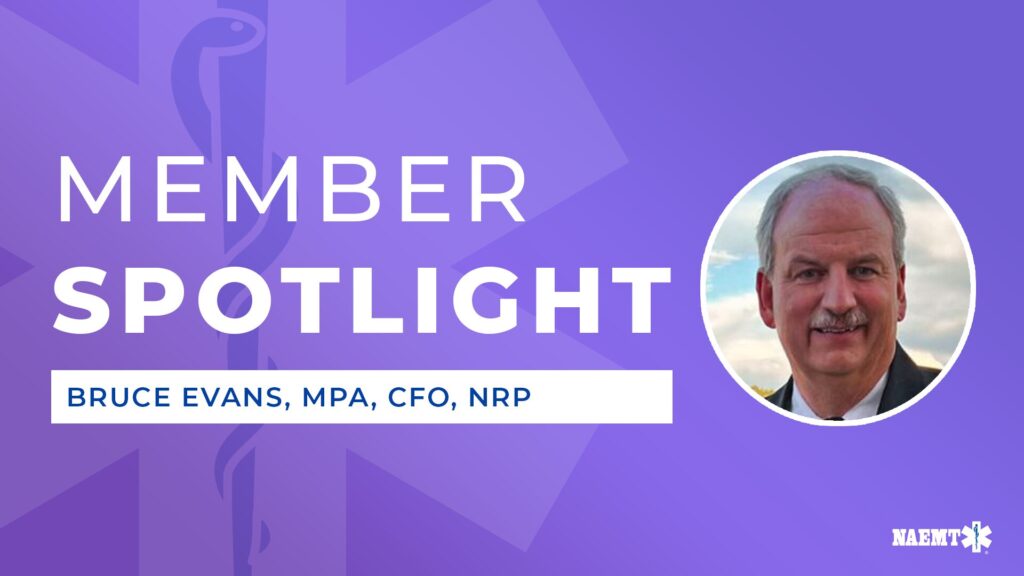
NAEMT Board of Directors: Getting to know the leaders who move our profession forward.
Bruce Evans, MPA, CFO, NRP, is the Fire Chief at the Upper Pine River Fire Protection District and served as NAEMT President from 2020–2021. With more than 40 years of experience across EMS, fire service, and education, including two decades as a college faculty member at the College of Southern Nevada, Bruce has helped shape the profession as an author, instructor, and national advisor. A 2010 recipient of the IAFC James O. Page Award for Leadership in EMS and the 2014 NAEMT Presidential Leadership Award, he continues to serve on national committees advancing EMS safety, education, and provider wellbeing. We asked Bruce to reflect on the mentors who shaped him, where he sees the profession heading, and what has kept him engaged with NAEMT for more than 20 years.
Q&A with Bruce Evans
Personal Reflection: Who was a mentor, partner, or instructor who made the biggest impact on you?
“Early in my career, Lee Thomas was my paramedic preceptor. He ensured I developed my clinical skills but taught me a lot about the perspective of this profession. Later in my career, Bob Forbuss, the former owner of Mercy Ambulance, Las Vegas, helped me develop my knowledge on the EMS industry, former Las Vegas Fire EMS Chief Ken Riddle on fire-based EMS, and on a national level with writing and leadership on the big picture, James O. Page.”
Industry: What new tech or tools do you think will really change how EMS works?
“AI is going to change our profession dramatically. It is already here with the interpretation made on all of the standard field EKG machines and the computer aided dispatch software, along with the vehicle data. Even an I-Watch is providing detailed data and alerting faster than a human. AI does not get fatigued or make decisions based on bias.”
Workforce and Leadership: What skills do you think new EMS professionals will need that maybe weren’t as important before?
“De-escalation, community resources, and treating the patient as a human being. That short time during a transport, you have an opportunity to make a connection versus having your head buried into your ePCR. Conversation in the back of an ambulance makes the ride a lot more pleasant.”
Advocacy: For everyday EMS providers, what’s the easiest way to get involved or make their voices heard?
“Writing, even if it is a short article for your local or state EMS association, gets your name recognized, and generally to accomplish that you’re doing a little research to make it interesting. Stepping up to participate in a local or state EMS related committee or a service club to be the EMS person in the community. The opportunity to get involved nationally, and local and state opportunities, prepares you for the big league.”
NAEMT Board Service: What made you say yes to joining the board—was it a specific issue, a person who encouraged you, or something else?
“In a cab ride to the airport from the Fire Department Instructors Conference (FDIC), then-NAEMT President Ken Bouvier asked me to rejoin and take on the NAEMT Safety Committee. That was more than 20 years ago, and I stayed involved with NAEMT because that is where the action was happening. It was the best place to make a difference.”
Bruce Evans’ career reflects four decades of showing up, from the back of an ambulance to the national stage shaping EMS policy and education.
From a cab ride conversation that turned into 20 years of board service to his conviction that AI will reshape the profession without losing sight of the human being in the back of the rig, Bruce’s story is a reminder that showing up consistently, over decades, is what leadership actually looks like. We thank Bruce for his continued leadership on the NAEMT Board of Directors and for his lifelong dedication to advancing EMS.
More Articles