
Member Spotlight: The Ripple Effect of EMS Education with Michael Kaduce
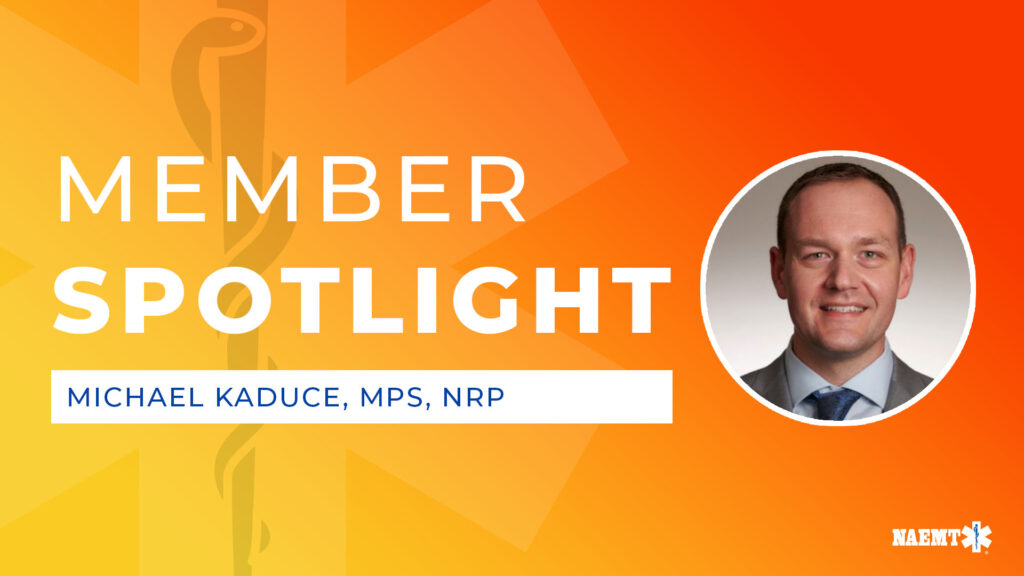
NAEMT Board of Directors: Getting to know the leaders who move our profession forward.
Michael Kaduce, MPS, NRP, is the Director of the Falck Health Institute, where he leads initial education initiatives for Falck, and serves as the West Coast Region Director on the NAEMT Board of Directors. His career spans from EMT and paramedic/firefighter in Iowa to EMS educator at the University of Iowa and program director for UCLA’s Center for Prehospital Care, where he oversaw the country’s largest EMT education program for six years. Michael holds a Master of Professional Studies in Homeland Security and Public Health, has authored some of the most widely used EMT and paramedic textbooks, and continues to teach NAEMT courses around the globe. We asked Michael to reflect on the lasting impact of teaching, where EMS education is headed, and what keeps him engaged with the board.
Q&A with Michael Kaduce
Personal Reflection: What’s a moment in your career that made you especially proud—or reminded you why this work matters?
“One of the proudest moments in my career wasn’t a single graduation or award. It was seeing former students return years later as field training officers, educators, and leaders who are now mentoring the next generation of EMS professionals. Education has a ripple effect. Every student we prepare has the potential to impact thousands of patients over the course of their career. That’s a responsibility I never take lightly.”
Industry: What new tech or tools do you think will really change how EMS works?
“I think artificial intelligence and immersive simulation will transform EMS education. As these technologies continue to evolve, they’ll allow students to practice in highly realistic environments with lifelike patients that respond dynamically to treatment decisions. Instead of memorizing protocols, learners will build clinical judgment through experience, making them better prepared for the variety and complexity of patients they’ll encounter in the field.”
Workforce and Leadership: What skills do you think new EMS professionals will need that maybe weren’t as important before?
“The next generation of EMS clinicians will need to become comfortable adapting to rapidly changing technology. We’re approaching a future where decision support tools will assist with assessment, diagnosis, documentation, and treatment recommendations in real time. At the same time, advances like whole blood, point-of-care ultrasound, and expanded community paramedicine will continue to reshape practice. The providers who thrive will be those who embrace lifelong learning and remain adaptable as our profession evolves.”
Workforce and Leadership: Any advice for someone who might want to get involved in EMS or NAEMT leadership?
“Don’t wait until you think you’re “ready.” Volunteer for a committee, attend meetings, ask questions, and say yes to opportunities that stretch you. Some of the most influential relationships in my career began because I was willing to raise my hand and get involved. Leadership isn’t about having all the answers. It’s about serving others, listening with humility, and leaving the profession better than you found it.”
NAEMT Board Service: What part of board work fills your cup the most?
“Working alongside passionate EMS professionals from across the country who all share the same goal: advancing EMS through education, advocacy, and leadership. Every board member brings a unique perspective shaped by their community and experiences. Those conversations challenge my own thinking and remind me that the best solutions come from collaboration. Knowing that our work helps strengthen the profession and support EMS providers nationwide is incredibly rewarding.”
Michael Kaduce’s career reflects a deep belief that education is one of the most powerful tools for advancing EMS.
From watching former students become the field training officers and educators shaping the next generation, to preparing providers for a future built on AI and immersive simulation, Michael’s story is a reminder that the impact of teaching never really ends. We thank Michael for his continued leadership on the NAEMT Board of Directors and for his dedication to strengthening EMS education worldwide.
More Articles