
NAEMT Celebrates 50 Years
Honoring the legacy of advocacy, education, and research in EMS
In 2025, NAEMT celebrates 50 years of advancing the EMS profession. This milestone provides an opportunity to reflect on the pivotal role of NAEMT, and perseverance of our members, in the growth of EMS over the last 50 years. What started as a small group of dedicated visionaries is now the leading professional organization for EMS professionals and a vital part of the EMS community.
THE STATE OF EMS BEFORE THE 1970s
Before the formation of NAEMT in the mid-1970s, the EMS system in the United States was inconsistent and unregulated, lacking the coordination and standardization we rely on today. Prehospital care during this time was basic, often provided by fire departments, police, or volunteers with limited medical training.
THE BIRTH OF MODERN EMS
Amidst a decade of social turmoil and transformation in the United States, President Lyndon Johnson and the U.S. Department of Transportation charged a task force with establishing standards for training and examining EMS personnel. Subsequently, the National Registry of Emergency Medical Technicians (NREMT) was established in 1970 under the leadership of Rocco Morando, sparking decades of improvements in prehospital medicine.
Creating a Unified Voice for EMS Professionals
With EMS still in its infancy, Morando and NREMT identified several challenges that EMS professionals face, such as limited recognition, lack of standardization, and inadequate resources. On January 8th, 1975, delegates from each known state EMS association gathered in Chicago,Illinois, thereby forming NAEMT. Under Morando’s founding leadership, the group worked to establish bylaws and membership requirements. With annual dues set at only $2, NAEMT began functioning as a national association of state associations.
THE LEGACY OF NAEMT
Now a freestanding organization with more than 110,000 members, NAEMT serves as the leading voice for EMS professionals and is the only national association representing all emergency and mobile healthcare practitioners across every sector of EMS. By advocating for policy change, implementing innovative training programs, and committing to EMS research, NAEMT has shaped the standards and practices that now define modern emergency medical care.
Today, most people anticipate receiving specialized, lifesaving care when they call for EMS.

Advancing EMS through Advocacy
Prior to the 1970s, if you asked someone what an EMT or a paramedic was, they likely would not have a clear answer, as the profession we know today did not exist. Today, most people anticipate receiving specialized, lifesaving care when they call for EMS. This growth in recognition can be largely attributed to the dedicated advocacy efforts of NAEMT and collaborations with other EMS organizations.
In its early years, NAEMT recognized that EMS was underfunded, underappreciated, and lacked sufficient representation in policy discussions. Through public education, adopting position statements, professional lobbying, and nationwide grassroots campaigns, NAEMT has influenced legislation to improve EMS care, promote fair compensation, and secure resources for EMS clinicians.
Held annually, EMS On The Hill Day serves as an important grassroots advocacy event organized by NAEMT. As the largest national advocacy event for EMS professionals, it allows attendees to meet with congressional members on Capitol Hill to lobby for important legislation. This event has facilitated the passage of bills that improve staffing, funding, training, and support for EMS personnel, such as the Supporting and Improving Rural EMS Needs Act (2018), Protecting Patient Access to Emergency Medications Act (2017), the Pandemic and All-Hazards Preparedness and Advancing Innovation Act (2013 & 2019).
Advocacy efforts have shifted over time to address the ongoing needs of the profession. In recent years, NAEMT mounted a dynamic response to the COVID-19 pandemic by advocating for EMS professionals to be included in the initial vaccine distribution and by seeking legislative support for increased funding. These advocacy efforts led to passing the American Rescue Plan Act (2021), which includes funding specifically allotted to EMS providers for training and equipment needs
A Commitment to Education
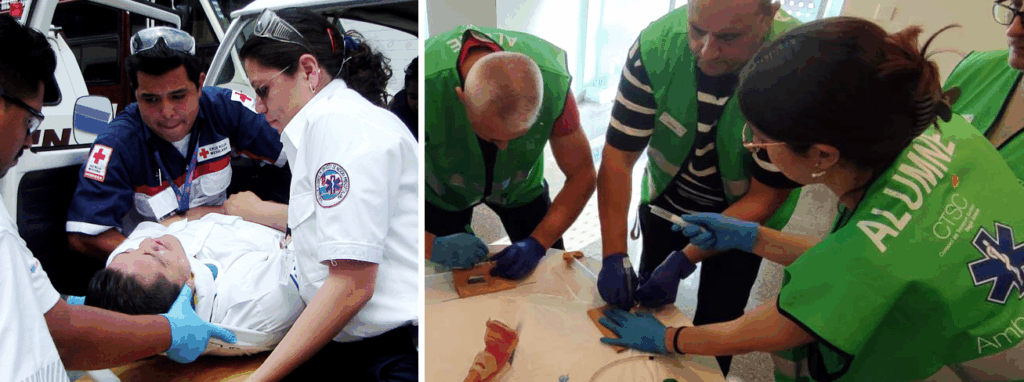
As early as the late 1970s, NAEMT hosted educational conferences and developed a well-respected journal with the tagline, “For EMTs, by EMTs.” In 1983, NAEMT rolled out its first formal course offering, the Prehospital Trauma Life Support (PHTLS) program. Today, PHTLS is internationally recognized as the leading continuing education program for prehospital emergency trauma care. Years later, the National Highway and Traffic Safety Association’s (NHTSA) 1996 EMS Agenda for the Future called for integrated, community-based health management. In response, NAEMT launched the first EMS education program that prepares EMS practitioners to assess and manage common medical conditions, known as the Advanced Medical Life Support (AMLS) course. Today, AMLS is the gold standard of education for emergency medical assessment and treatment. As healthcare has changed over the years, NAEMT has led the way in addressing the educational needs of EMS practitioners. Today, NAEMT offers a variety of courses covering prehospital trauma care, prehospital medical care, EMS operations, and bystander training.
Innovation and Research
Advancing education in EMS could not be done without a commitment to research. Research conducted by NAEMT in the 1980s played an important role in creating the PHTLS course and accompanying textbook, marking a significant advancement in establishing evidence-based care for EMS clinicians.
Over the years, NAEMT has prioritized research to ensure the delivery of high-quality patient care, with numerous course updates that reflect current evidence-based practice.
In working towards the NHTSA’s 1996 EMS Agenda for the Future, NAEMT collaborated with federal partners to research and develop the National EMS Education Standards, which serve as the framework for EMS training that is still used today. Over the years, NAEMT has prioritized research to ensure the delivery of high-quality patient care, with numerous course updates that reflect current evidence-based practice. As the only national association representing EMS practitioners, NAEMT’s research also supports advocacy efforts. By conducting surveys of its members throughout the profession, NAEMT identifies workforce challenges and seeks legislative support when necessary. For instance, in response to the 2016 National Survey on Data Collection,Use, and Exchange in EMS, NAEMT collaborated with key stakeholders to establish the “National Vision for the Collection, Reporting, Use, and Exchange of EMS Data,” which has aided in the integration of EMS as part of the value and outcomes-based healthcare system.
ADAPTABILITY AND PERSEVERANCE
Among NAEMT’s numerous accomplishments over the past 50 years, a recurring theme is the ability to adapt to the ever-changing healthcare system. Time after time, NAEMT has quickly responded to multiple major events that have shaped the landscape of EMS. In the aftermath of the September 11, 2001 attacks and the rise in active shooter and mass casualty incidents that followed, NAEMT played a pivotal role in improving the preparedness of EMS practitioners. NAEMT advocated for increased funding for EMS agencies, emphasizing the need for enhanced equipment and training. New training programs, such as the Tactical Emergency Casualty Care (TECC) course, equip EMS practitioners for these highrisk environments. Federally, NAEMT advocated for EMS involvement in disaster preparedness planning.
Following the passage of the Affordable Care Act in 2010, which triggered a significant shift in the healthcare system, NAEMT joined forces with other key stakeholders in the EMS community to strategize for the industry’s future. This collaboration resulted in the formation of the Mobile Integrated Healthcare-Community Paramedicine (MIH-CP) Committee and various initiatives to tackle the evolving healthcare landscape, including the World Trauma Symposium and the National EMS Safety Council. During the early stages of the COVID-19 pandemic in 2020, NAEMT provided a dynamic response in advocacy, education, and research. NAEMT advocated for the prioritization of EMS personnel in vaccination efforts, provided resources to EMS professionals during the rapidly evolving situation, and conducted national surveys to gain insight into the experiences of EMS professionals. NAEMT also partnered with national hotel chains to provide more than one million bookings for EMS professionals to help shield their families from infection. Our partnership with Amazon Business Prime gave access to PPE equipment and supplies not readily available.
NAEMT remains committed to addressing these systemic issues through ongoing advocacy, education, and research.
A VISION FOR TOMORROW
The COVID-19 pandemic has left a lasting impact on the field of EMS. Workforce shortages, reimbursement issues, and increased stress on EMS providers continue to be challenges faced by the profession. A key focus right now is developing a treat-in-place model, advocating for a shift from transport based reimbursement to payment for services that may be rendered on scene. Looking ahead, NAEMT remains committed to addressing these systemic issues through ongoing advocacy, education, and research. Today and for the next 50 years, NAEMT looks forward to building a brighter future for EMS, where challenges are faced with resilience, progress, and dedication to improving emergency medical care.
As we celebrate this milestone, we recognize the contributions of each of our members and the greater EMS community
THE POWER OF COMMUNITY
By uniting members of the EMS community with a common goal, NAEMT creates a supportive network where members can collaborate, learn, and advocate together for a better EMS system. Whether through shared education, collective research efforts, or advocating for policy change, NAEMT harnesses the power of its community to drive change in the EMS profession. From humble beginnings to becoming the leading voice for EMS professionals, celebrating NAEMT’s 50th anniversary showcases the dedication of many people. As we celebrate this milestone, we recognize the contributions of each of our members and the greater EMS community. Whether you respond to emergencies or work tirelessly behind the scenes to improve EMS systems, your commitment to the profession is at the heart of our success. NAEMT extends its sincere gratitude to you, our valued members.

Learn more about NAEMT membership.
More Articles