
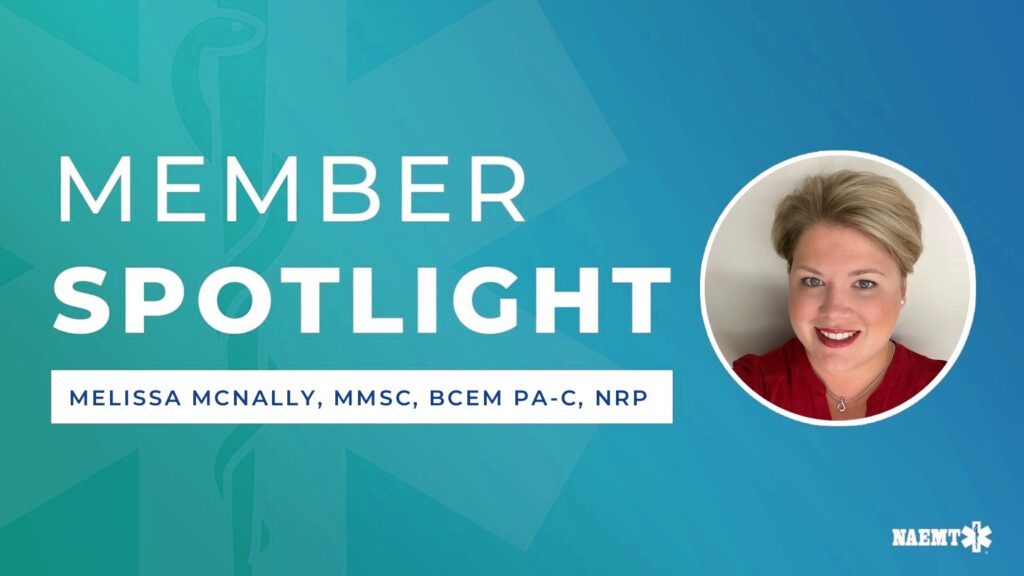
Member Spotlight: Giving EMS a Stronger Voice with Melissa McNally
NAEMT Board of Directors: Getting to know the leaders who move our profession forward.
Melissa McNally, MMSc, BCEM PA-C, NRP, is a board-certified emergency medicine physician assistant and nationally registered paramedic with extensive experience in mobile integrated healthcare, disaster medicine, telemedicine, and EMS. She works in the emergency department at AdventHealth and HCA, serves as Assistant Medical Director for HCA EMS Transport Services at Brandon Hospital, and owns a Florida EMS training center providing education, training, and consulting services. Melissa serves as the Gulf Coast Region Director on the NAEMT Board of Directors and is a member of the Events Committee and Membership Committee. We asked Melissa to share the defining moment that shaped her career, her hopes for the next generation of EMS, and what continues to drive her advocacy work.
Q&A with Melissa McNally
Personal Reflection: What’s a moment in your career that made you especially proud—or reminded you why this work matters?
“Responding to the crash of United Flight 93 on September 11, 2001, was one of the most defining moments of my career. It reinforced something I’ve carried with me ever since: EMS exists for moments when people need us most. While none of us ever hope to face an event of that magnitude, it reminded me that our profession is built on service, preparation, and a commitment to others, no matter the circumstances.
What I took away from that experience wasn’t just the importance of clinical skills or operational readiness. That experience also reinforced the importance of teamwork. No one responds to an event like that alone. It takes people from different agencies, backgrounds, and disciplines working together toward a common purpose. The strongest organizations are those that collaborate, communicate, and never lose sight of the mission.
Finally, Flight 93 gave me a deeper appreciation for the responsibility we have to leave this profession stronger than we found it. We owe it to the next generation of EMS professionals to prepare them, advocate for them, and ensure they have the training, support, and resources they’ll need to meet whatever challenges lie ahead. If my career has taught me anything, it’s that we can never predict the next extraordinary moment—but we can choose to build a profession that is ready for it.”
Industry: What do you hope EMS looks like for the next generation coming in behind you?
“My hope for the next generation of EMS is that they inherit a profession that has a stronger voice than the one I entered. I want EMS to be recognized as an essential part of the healthcare system—not just when there’s a crisis, but every day. That means advocating for better education, fair compensation, strong mental health resources, and career pathways that allow providers to grow without leaving the profession.”
Workforce and Leadership: What skills do you think new EMS professionals will need that maybe weren’t as important before?
“The fundamentals of EMS haven’t changed. Patients still need clinicians who are compassionate, technically competent, and able to make good decisions under pressure. Those skills are timeless.
Where I think the next generation will need to grow is in areas that weren’t emphasized as much when I started. They’ll need to be effective advocates—for their patients, for their profession, and for themselves. They’ll need to understand healthcare systems, public policy, reimbursement, and how decisions made in boardrooms and legislatures affect the care delivered in the field.
They’ll also need to be comfortable leading through change. EMS is evolving rapidly with new technology, community paramedicine, mobile integrated healthcare, and data-driven decision-making. The providers who thrive will be the ones who can adapt without losing sight of the human side of this profession.”
Advocacy: For everyday EMS providers, what’s the easiest way to get involved or make their voices heard?
“The easiest way for everyday EMS providers to get involved is to start local. Join your state EMS association, attend a meeting, volunteer for a committee, or simply build a relationship with your local leaders. Advocacy doesn’t always mean testifying before a legislature. Sometimes it’s sharing your experience, mentoring a new provider, or helping your community understand what EMS really does.
I’d also encourage providers to tell their stories. The public and policymakers make better decisions when they hear directly from the people doing the work. Our experiences—from routine calls to extraordinary events—help people understand the value of EMS and why investing in the profession matters.
Finally, don’t assume your voice doesn’t matter. Every improvement in EMS started because someone decided to speak up. Whether it’s supporting your professional association, responding to a call for action, or simply educating an elected official about the realities of our job, those small actions add up. Advocacy isn’t reserved for a few leaders—it’s the responsibility of all of us.”
NAEMT Board Service: What part of board work fills your cup the most?
“The most rewarding part of board service for me is knowing that the work we do creates opportunities and improves the profession for the providers who will come after us. I enjoy helping shape the direction of EMS through advocacy, strategic planning, and policy—not because of the title, but because those decisions have a real impact on the people serving in the field every day.
What fills my cup is giving EMS a stronger voice. Whether that’s advocating for providers, mentoring future leaders, building partnerships, or helping move meaningful initiatives forward, I find the greatest satisfaction in leaving the profession stronger than I found it.
Just as important is connecting with our members. Hearing their stories, understanding the challenges they face, and making sure their voices are represented in the decisions we make reminds me why this work matters. Our members are the heart of the organization, and board service is about ensuring they have the support, resources, and representation they deserve.
My career has taught me that the most important work often happens behind the scenes. Board service is one of those places where thoughtful leadership can create lasting change. Knowing that our work today may improve the careers of future EMS professionals, strengthen our membership, and ultimately improve the care our patients receive is what makes it worthwhile.”
Melissa McNally’s career reflects a lifelong commitment to service, advocacy, and leaving the profession stronger than she found it.
From responding to the crash of United Flight 93 to championing a stronger voice for EMS providers today, Melissa’s story is a reminder that meaningful change often starts with showing up when it matters most. We thank Melissa for her continued leadership on the NAEMT Board of Directors and for her dedication to advancing EMS across Florida and beyond.
More Articles