
Member Spotlight: Building Leaders and Elevating EMS with David Blevins
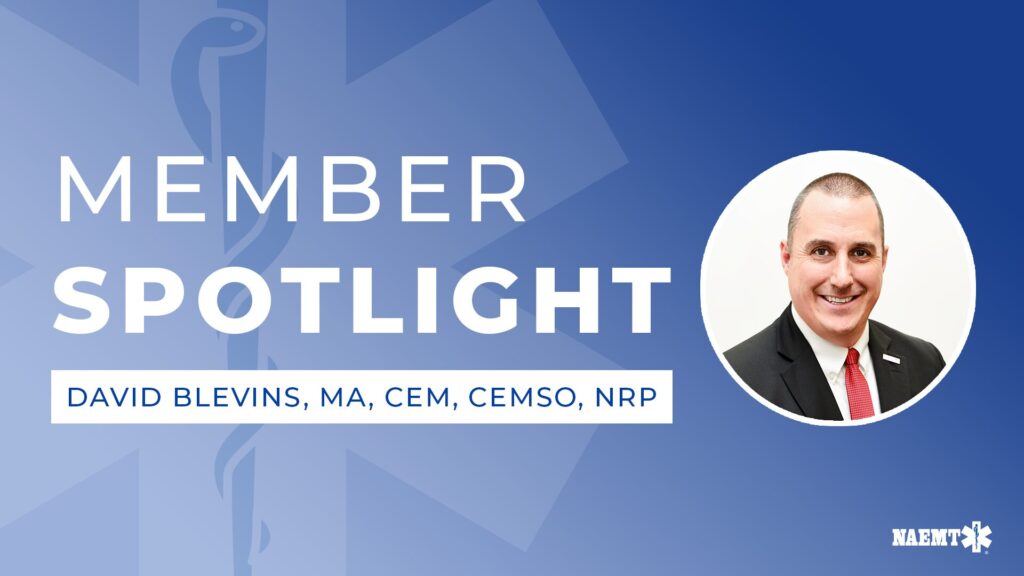
NAEMT Board of Directors: Getting to know the leaders who move our profession forward.
David Blevins, MA, CEM, CEMSO, NRP, is the NAEMT Southeast Coast Region Director for the 2026–2027 term and Director of EMS Education Programs at Roane State Community College. With more than two decades of experience across EMS, fire services, emergency management, and education, David brings a strong focus on mentorship, leadership development, and advancing the profession. We asked David to share the influences that shaped his career, the lessons he’s learned, and his perspective on the future of EMS.
Q&A with David Blevins
Personal Reflection: Who was a mentor, partner, or instructor who made the biggest impact on you?
“The person who made the biggest impact on me was my grandmother, Betty Piper—Tennessee EMT License #0753. At a time when women were often limited in the roles they were allowed to hold, she broke barriers and rewrote expectations. She was the sole reason I found my way into EMS. When my family moved back to Tennessee and I was just eight years old, I began helping her teach CPR classes—first as the CPR ‘dummy,’ then carrying equipment, and eventually becoming an instructor myself.
Through every step, she instilled in me the belief that knowledge is meant to be shared as widely as possible. She held many leadership roles, including serving on the board of a rescue squad that, at the time, did not even allow female responders. Respected, determined, and unapologetically committed to the profession, she didn’t just shape my career—she shaped who I am.”
Career Reflection: If you could give a piece of advice to your younger self starting out in EMS, what would it be?
“The best advice I could give my younger self starting out in EMS is to learn how to say ‘no.’ Early in your career, it’s easy to believe that saying yes to everything is how you prove your value. In reality, using ‘no’ thoughtfully and effectively allows you to do more of what truly matters—better patient care, meaningful leadership, and sustainable professional growth. Boundaries aren’t a weakness; they’re a skill. Say no when you need to, say it with intention, and always say it with kindness. Doing so will protect your passion, your professionalism, and your longevity in this field.”
Industry: If you could change one thing about EMS—big or small—what would it be?
“If I could change one thing about EMS, it would be how our clinicians are recognized as healthcare providers. For far too long, EMS has been viewed primarily as a transportation service—a perception rooted in the Accidental Death and Disability white paper era. That reality no longer reflects what we do.
Today’s EMS clinicians are the next generation of healthcare professionals. With the growth of treat-in-place legislation and the expansion of Mobile Integrated Healthcare and Community Paramedicine, our clinicians at every level are delivering meaningful, patient-centered care in more settings and with greater frequency than ever before. It’s time our system, policies, and public perception fully acknowledge EMS for what it has become: an essential component of the healthcare continuum.”
Workforce and Leadership: What should be done to bring a variety of perspectives into EMS leadership?
“To bring a wider range of perspectives into EMS leadership, we need to be more intentional about how—and from whom—we develop leaders. Like any industry, EMS has its share of strong leaders and weak ones. As a profession, we should start elevating individuals who have demonstrated not only clinical expertise, but also sound leadership and business principles.
Some of the most impactful lessons come from outside our profession—ideas like Dale Carnegie’s emphasis on connection and influence, or Richard Branson’s belief that you don’t put the customer first; you put the employee first, and they will take care of the customer every time. One of my favorite quotes captures this perfectly: ‘What if we train them and they leave?’ to which the response is, ‘What if we don’t—and they stay?’
If we want diverse perspectives at the leadership table, we must be willing to invest in people—empower them with knowledge, trust, and opportunity. When you do that, EMS professionals don’t just grow into leaders; they exceed expectations and help move our profession forward in ways we never imagined.”
Advocacy: For everyday EMS providers, what’s the easiest way to get involved or make their voices heard?
“The easiest way for everyday EMS providers to get involved is to recognize that their voice matters—regardless of title, certification level, or years of experience. Our clinicians are the lifeblood of this profession, and every single voice deserves to be heard.
One of the simplest and most impactful tools available is the NAEMT Online Legislative Service (OLS). It empowers every EMS professional to engage in advocacy with just a few clicks. You select the issue, enter your address, and the system automatically prepares a message to your Representative or Senator. Click ‘send,’ and your voice is officially part of the conversation shaping the future of EMS.
The best part? You can complete every active OLS campaign in ten minutes or less, yet those minutes can have a lasting impact on our profession. It’s proof that meaningful change doesn’t always require a microphone or a podium—sometimes it just takes showing up, clicking a button, and standing up for the profession we’re proud to serve.”
NAEMT Board Service: What part of board work fills your cup the most?
“What fills my cup the most in board work is simply talking with the members. As a membership-driven association, our responsibility is to hear directly from the people living the realities of this profession every day.
I’ve had the opportunity to travel throughout my region, and while the challenges EMS faces are often remarkably similar, each state brings its own unique nuances and perspectives. What never changes, though, is the people. Our clinicians—no matter the geography—are strong, resilient, and deeply compassionate toward the communities they serve.
Hearing their concerns, their ideas, and their passion reminds me why this work matters. Knowing that the board is actively taking up issues that strengthen their association and advance their profession is incredibly rewarding.”
David Blevins’ career reflects a deep commitment to mentorship, leadership development, and advancing EMS through education and advocacy.
From his early experiences learning alongside his grandmother to his work developing future EMS leaders, David’s journey is rooted in the belief that investing in people is the key to long-term success. His perspective on leadership—centered on intention, growth, and shared knowledge—serves as a powerful reminder that the future of EMS depends on those willing to develop others and challenge the status quo. We thank David for his leadership on the NAEMT Board of Directors and for his continued dedication to strengthening the profession for generations to come.
More Articles