
Member Spotlight: Leading with Purpose and Lifelong Learning with Chris Cebollero
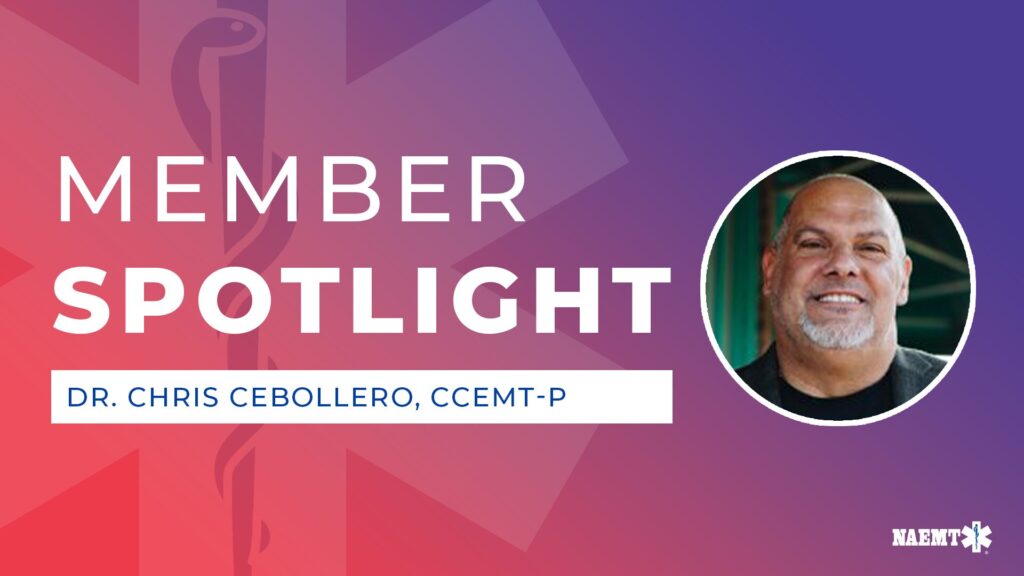
NAEMT Board of Directors: Getting to know the leaders who move our profession forward.
Dr. Chris Cebollero, CCEMT-P, is the NAEMT Great Plains Region Director and a nationally recognized EMS leader, advocate, author, speaker, and podcast host. As Chief Operating Officer at EMS Team, Chris has dedicated his career to helping EMS professionals grow as clinicians, leaders, and advocates for the profession. With experience spanning operations, education, business, and healthcare leadership, he brings a unique perspective on what it takes to build strong organizations and strong people. We asked Chris to reflect on the mentors who influenced him, the lessons he wishes he had learned sooner, and the leadership principles that continue to guide his work today.
Q&A with Chris Cebollero
Personal Reflection: Who was a mentor, partner, or instructor who made the biggest impact on you?
“Ernie Rodriguez had the most significant impact on my professional development. As Chief of MedStar, he was one of the first leaders who truly made me believe that my potential was far greater than I had imagined. He challenged me to think differently, lead with confidence, and continuously strive for excellence.
The lessons he shared were not only powerful in the moment but have remained with me throughout my career. His mentorship helped shape my leadership philosophy, decision-making, and commitment to serving others. Without his guidance, encouragement, and belief in me, I would not be the leader I am today.”
Career Reflection: If you could give a piece of advice to your younger self starting out in EMS, what would it be?
“I actually wrote a book based on a simple but profound question: If you could get into a time machine and go back to speak with your younger self, what is the one piece of advice that would make your journey easier?
My answer would be simple: Shut up and listen more.
When I was younger, I thought I had all the answers. I believed I was smarter than I was, more experienced than I was, and more important than I was. The truth is, I had a healthy ego and not nearly enough humility. Too often, I allowed my emotions to dictate my actions rather than letting wisdom and patience guide my decisions.
Looking back, I realize that some of my greatest lessons came from people I should have listened to more carefully. Experience taught me that leadership is not about having all the answers. It is about remaining curious, staying teachable, and understanding that every person you meet has something valuable to teach you.
If I could give my younger self one piece of advice, it would be this: Listen more than you speak. Learn more than you teach. Stay humble enough to know that growth begins the moment you realize you do not know everything.
That advice would have saved me a lot of mistakes and made my journey much easier.”
Industry: If you could change one thing about EMS—big or small—what would it be?
“One of the biggest challenges facing EMS today is that we are still not fully recognized as healthcare providers within the reimbursement system. Every day, paramedics and EMTs perform patient assessments, provide clinical interventions, educate patients, coordinate care, and help prevent unnecessary emergency department visits and hospital admissions. Yet, our ability to bill for those services remains extremely limited.
In the Mobile Integrated Healthcare (MIH) and Community Paramedicine space, there are numerous CPT codes that align with the services EMS professionals provide. However, unlike many other healthcare disciplines, EMS agencies and providers are often unable to directly bill for those services. In many cases, physicians, nurse practitioners, and other recognized providers can perform similar work and bill for reimbursement under their provider status, while EMS clinicians cannot.
If healthcare is truly moving toward value-based care, prevention, and community-based treatment, EMS must be recognized as an integral part of the healthcare continuum. Our profession has evolved far beyond simply transporting patients from point A to point B. We are educated clinicians delivering care where patients live, work, and need us most.
The future of EMS depends on achieving provider recognition and creating reimbursement models that reflect the value we bring to patient care, population health, and healthcare system efficiency.”
Workforce and Leadership: Any advice for someone who might want to get involved in EMS or NAEMT leadership?
“Leadership is a verb, not a noun. It is something you demonstrate every day through your actions, decisions, and interactions with others. Leadership is not defined by a title, position, rank, or past achievements. It is defined by how you show up consistently and the impact you have on those around you.
For anyone aspiring to take on a position of responsibility within their agency or within NAEMT, the first step is developing strong self-awareness. Before you can effectively lead others, you must first understand yourself. You need to know your strengths, weaknesses, motivations, biases, and the reasons behind your behaviors and decisions. When you understand your own “why,” you become a more authentic, effective, and trusted leader.
I have always believed that if we consider ourselves professionals, we should belong to and actively support a professional organization. Professional organizations help elevate standards, advocate for our profession, and create opportunities for growth and development. That is why I value NAEMT. At its core, NAEMT is committed to advancing EMS and improving the profession for field providers. Through advocacy, education, leadership development, and professional engagement, it gives EMS professionals a voice and a pathway to help shape the future of our profession.”
Advocacy: For everyday EMS providers, what’s the easiest way to get involved or make their voices heard?
“The easiest way for everyday EMS providers to get involved and make their voices heard is to start where they are. Too often, people believe they need a title, a leadership position, or years of experience before they can influence the profession. The truth is that meaningful change often begins with engaged field providers who are willing to speak up, participate, and contribute.
One of the best ways to get involved is by joining and actively participating in professional organizations such as NAEMT. Attend meetings, participate in surveys, volunteer for committees, respond to advocacy alerts, and share your experiences. Organizations need to hear directly from the providers who are caring for patients every day because those perspectives help shape policy, education, and the future direction of EMS.
I also encourage providers to become involved locally. Attend agency meetings, participate in quality improvement initiatives, mentor newer providers, and look for opportunities to solve problems rather than simply identify them. Leadership is not a position; it is action. Every provider has the ability to influence their agency, their community, and their profession.
If every EMS professional took one small step to become more engaged, the collective voice of our profession would be impossible to ignore.”
Chris Cebollero believes leadership is not something you achieve—it is something you practice every day.
Throughout his career, Chris has challenged EMS professionals to remain curious, stay teachable, and invest in their own growth. His reflections on humility, self-awareness, and professional engagement serve as a reminder that meaningful leadership begins long before a title is earned. We thank Chris for his leadership on the NAEMT Board of Directors and for his continued commitment to developing the next generation of EMS leaders.
More Articles